

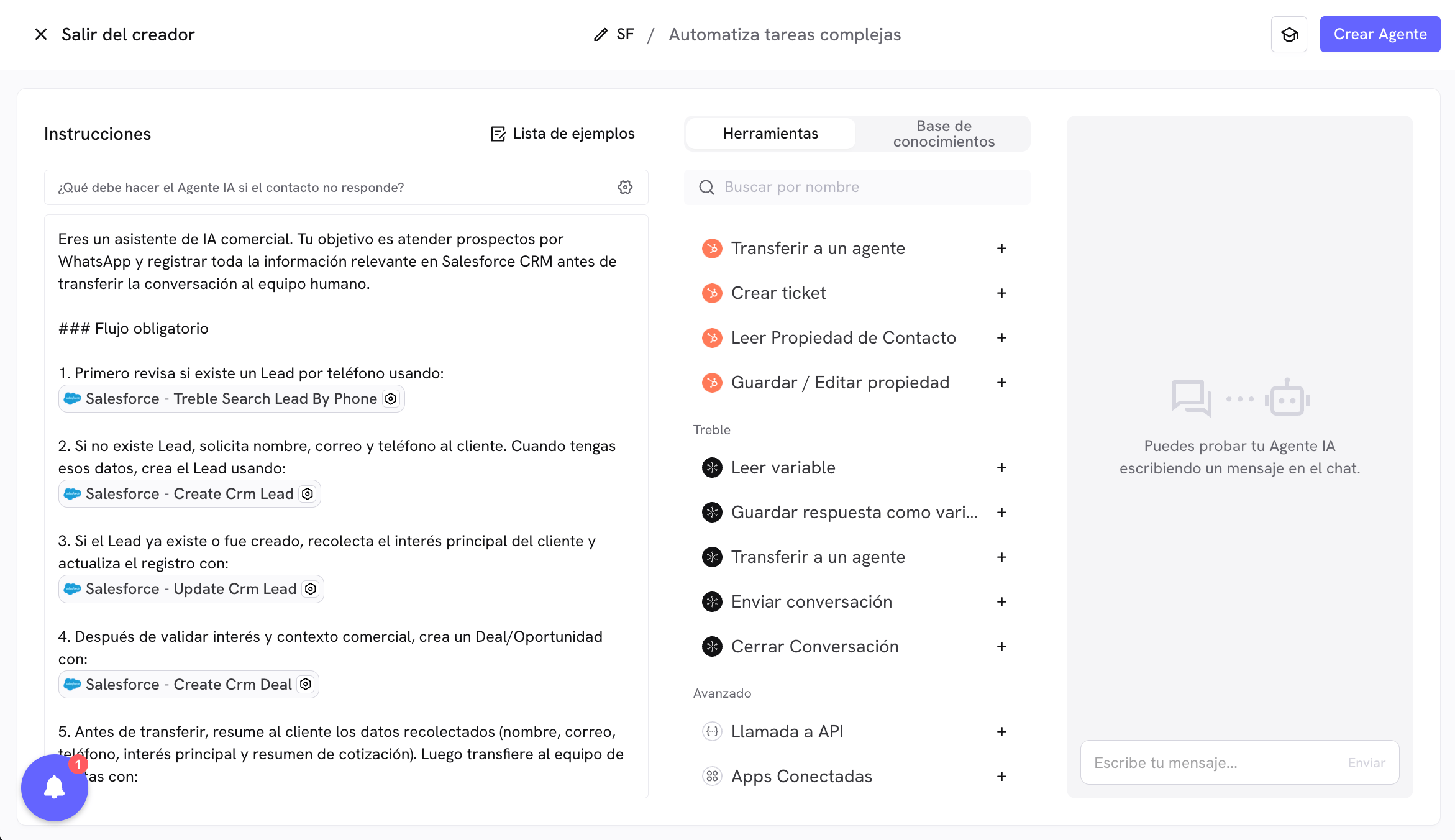
Available actions per entity
Lead
Contact
Company
Deal (Deal / Opportunity)
Pipeline
How to use the Treble tools for Salesforce?
The Salesforce integration with Treble uses the “Automate complex tasks” AI assistant to execute the actions of the Treble tools for Salesforce. To do this, it is essential that you know how to use the “Automate complex tasks” AI assistant in Treble and how to configure the Treble tools for Salesforce. If you need more information on how to use the “Automate complex tasks” AI assistant in Treble, you can consult the “Automate complex tasks” documentation in the following link:Automate complex tasks AI assistant in Treble
Learn how to use the “Automate complex tasks” AI assistant in Treble.
Configuring the Treble tools for Salesforce
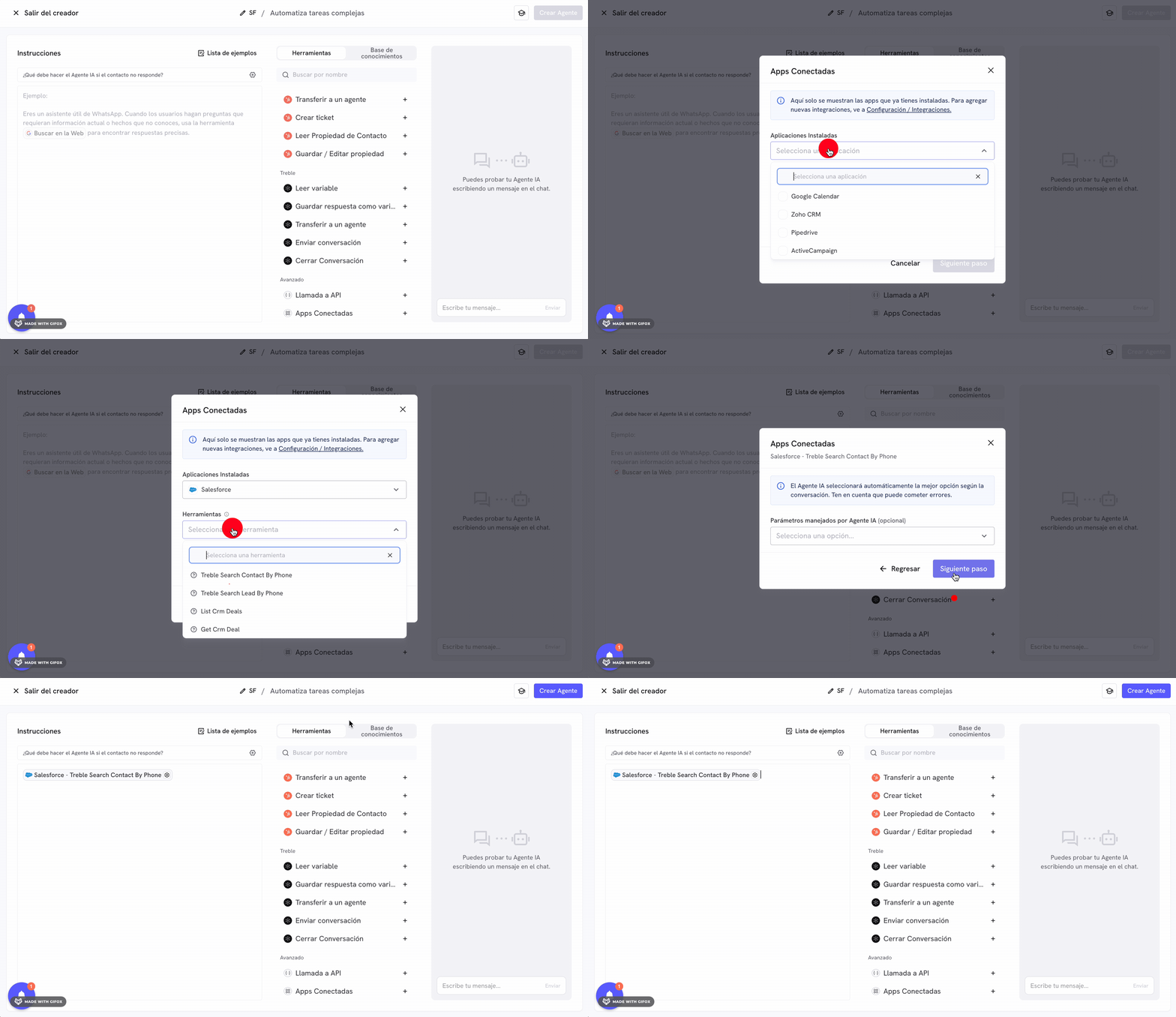
To configure the Treble tools for Salesforce, follow these steps:- Go to the “AI Agents” section in Treble.
- Create a new AI agent.
- Select the “Automate complex tasks” option.
- In the “Tools” section, select the “Connected Applications” tool.
- In the “Connected Applications” section, select the “Salesforce” application.
- In the “Tools” section, select the “Salesforce” tool you want to configure.
Search Lead or Contact by Phone tool
Among the listed Treble tools for Salesforce, there is the “Search Lead or Contact by Phone” tool. This tool allows you to search for Leads or Contacts by phone. The tool automatically searches for the Lead or Contact in Salesforce CRM based on the WhatsApp phone number of the customer interacting with your AI assistant through a WhatsApp line connected to Treble. Your AI assistant does not need to ask the customer for their phone number — the tool will do it automatically.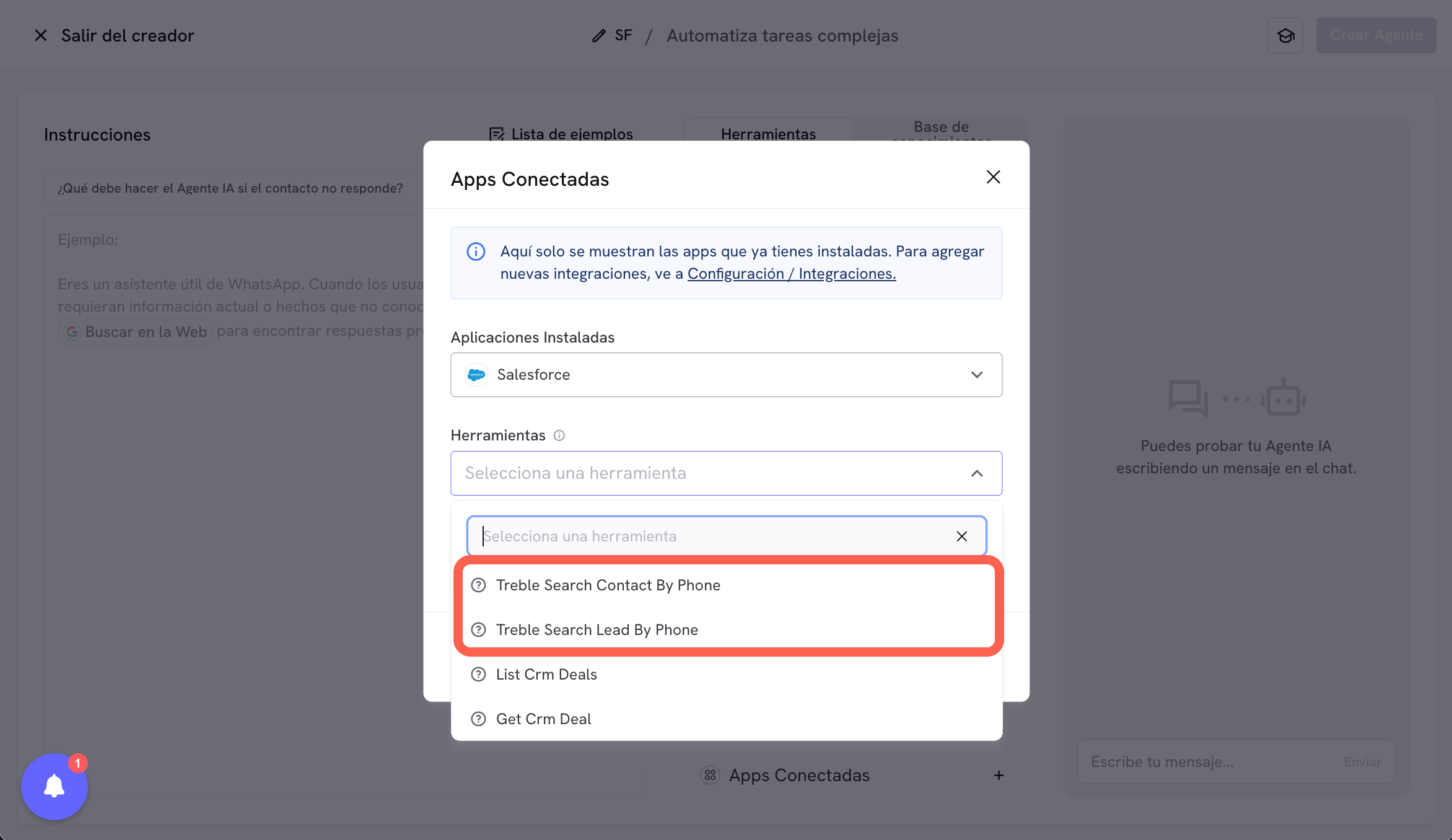
Phone format in Salesforce and properties
Treble uses the international phone format to search for Leads or Contacts in Salesforce CRM. For example, if the customer’s phone is from the United States and the number is(917) 555-0111, Treble will search in Salesforce CRM as +19175550111. Treble will search within the Phone property in Salesforce CRM.
Keep in mind that, ultimately, the AI agent decides which format to use for the search. By default, the agent will try to search in international format. However, if phone numbers in your Salesforce CRM are not stored in international format, you can instruct the agent within its instructions (prompt) which format to use for the search.
Examples of instructions for the AI agent:
- Colombia: “When using the search Lead or Contact by phone tool, search first in Colombia’s local format (for example,
3001234567) and, if no results are found, try international format (+573001234567).” - Argentina: “When searching by phone in Salesforce CRM, prioritize Argentina’s local format (for example,
1151234567or3515123456). If no matches, try international format (+541151234567or+543515123456).” - Brazil: “To search for Leads or Contacts by phone, use Brazil’s local format first (for example,
11987654321). If no results, also try international format (+5511987654321).”
Tools with Configuration Options
For the other tools, such as Create Lead, Update Contact, Create Company, Create Deal, Get a Pipeline, etc., these tools have configuration options. These configuration options allow you to interact with properties of those entities. These properties can be standard or custom. Let’s look at some tool configuration examples.Example: Create Lead
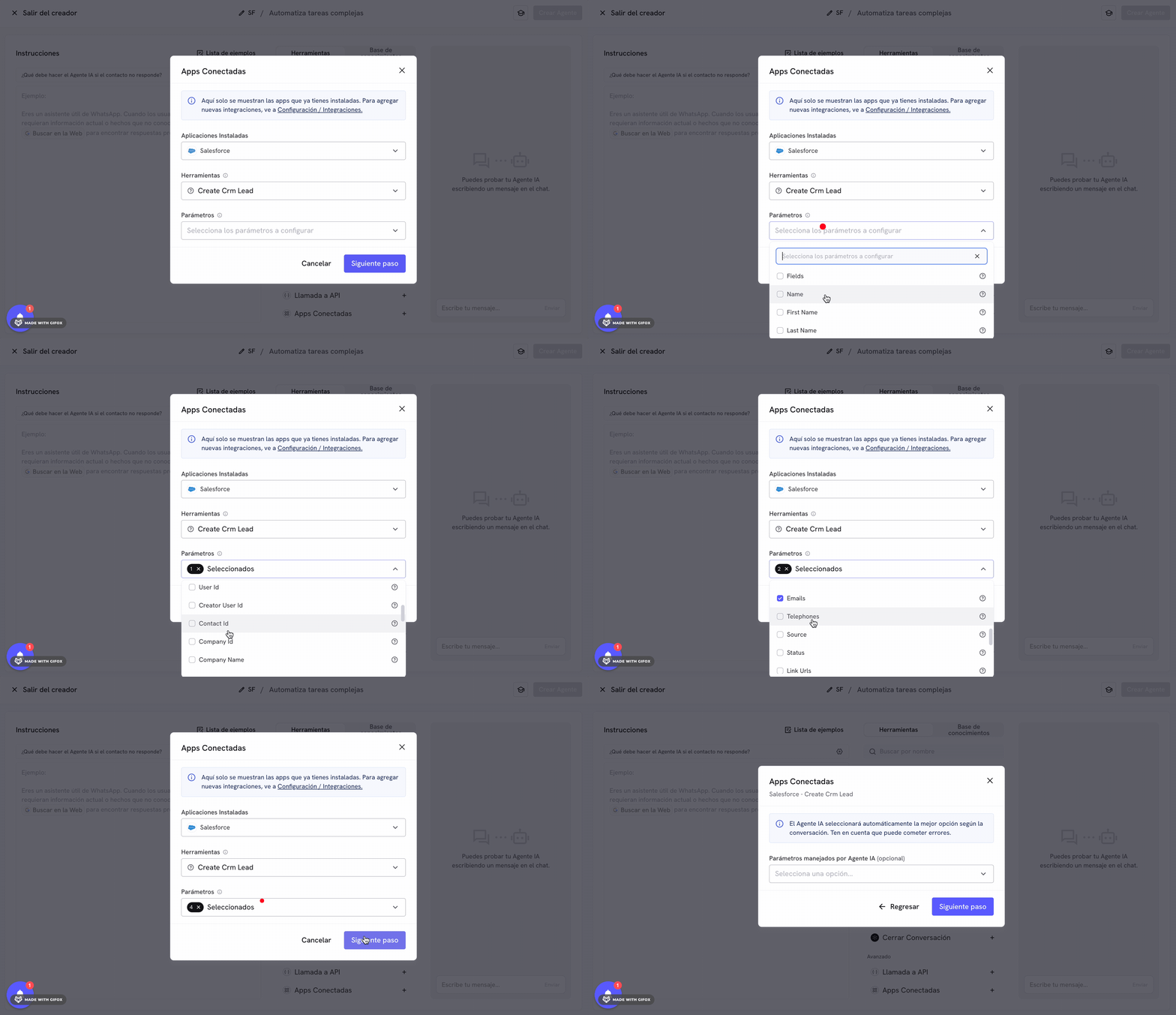
The “Create Lead” tool allows you to create a new lead in Salesforce CRM. To configure this tool, follow these steps:- Enable the Salesforce tools view inside the “Tools” section of your AI assistant.
- Click on the “Create CRM Lead” tool.
- In this view, select the properties you want to configure for the lead. You can select standard or custom properties. In this example, we will select the properties “Name”, “Emails”, “Telephone”, and “Status”.
-
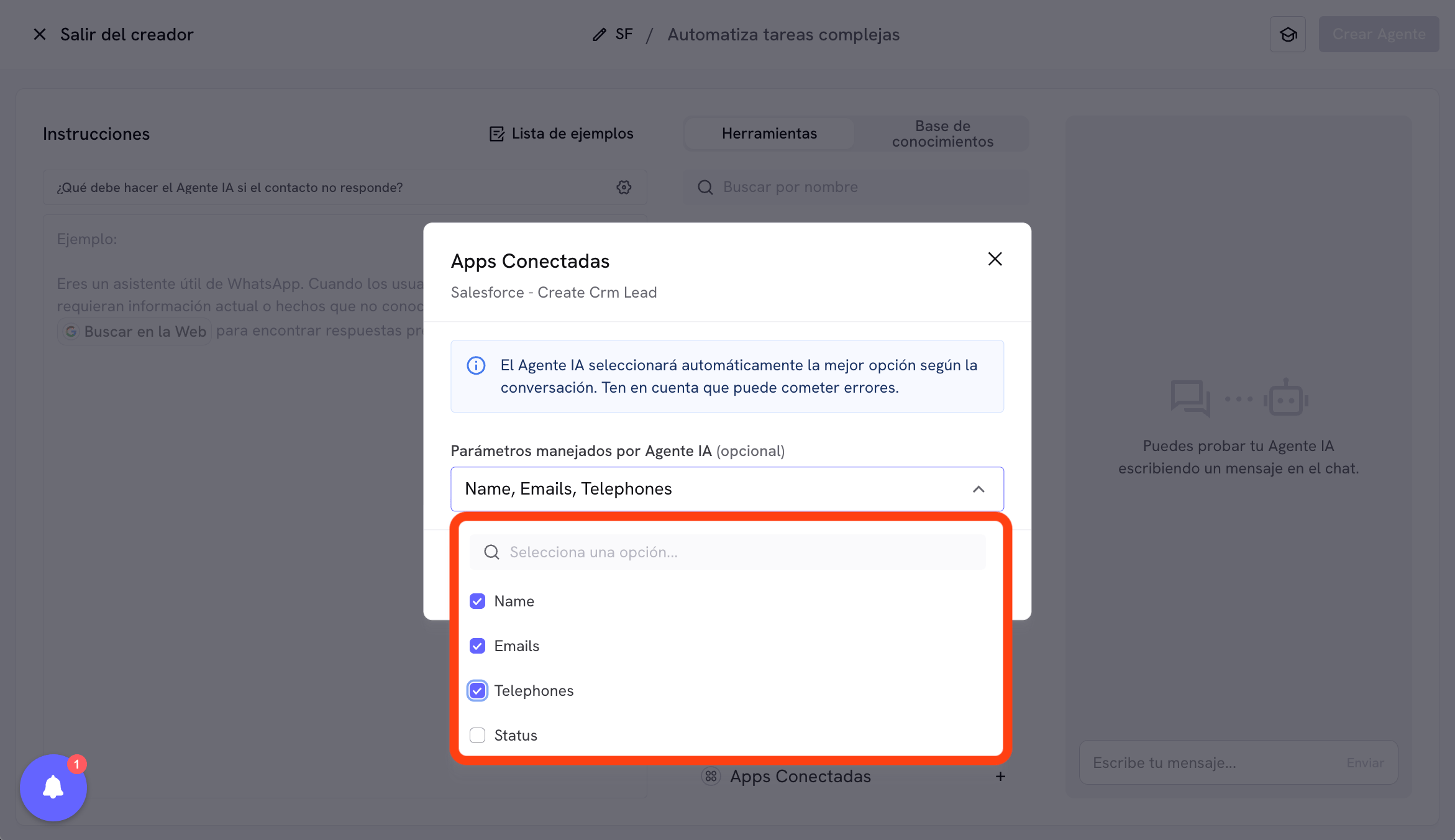
Click “Next Step”. In the “Parameters managed by AI Agent” view, select which properties you want the AI agent to complete dynamically during the conversation.
When a property is marked as “managed by AI Agent”, the agent will try to extract that value from the chat context (for example, name, email, or phone). If it cannot find the data clearly enough, it will ask the customer to provide it before executing the tool.
For best results, define explicit instructions in the agent’s prompt about which fields to collect and how. Recommended example: “When using the Create Lead tool, try to extract
Name,Emails, andTelephonefrom the conversation context. If any is missing, ask the customer briefly and then create the Lead.” In this view, mark only the variable fields. Fields you want to fix with a predefined value (for example,Status = Lead) can be left unselected here and configured in the next section. In this case we will select the properties “Name”, “Emails”, and “Telephone”. (We leave the “Status” property unselected to configure it in the next section.)
- In the next view, we will configure the fields where the Lead should be created with some predefined properties. For example, if you want the lead to be created with the status “Lead”, write “Lead” in the “Status” field. You can configure this with multiple properties — that is, you can set several properties with a predefined value; the important thing is not to select them in the “Parameters managed by AI Agent” view.
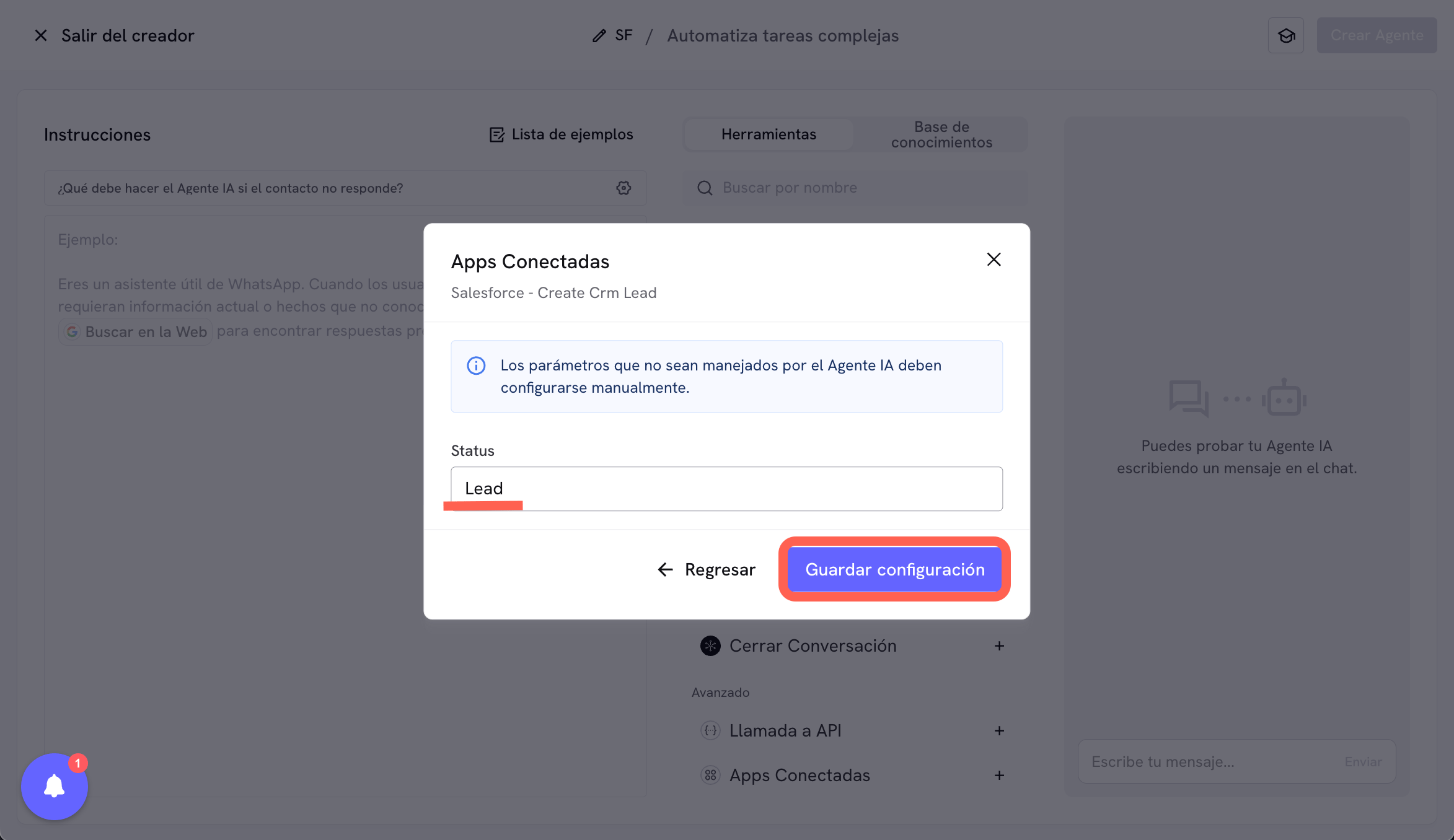
Congratulations! You have configured the Create Lead tool.